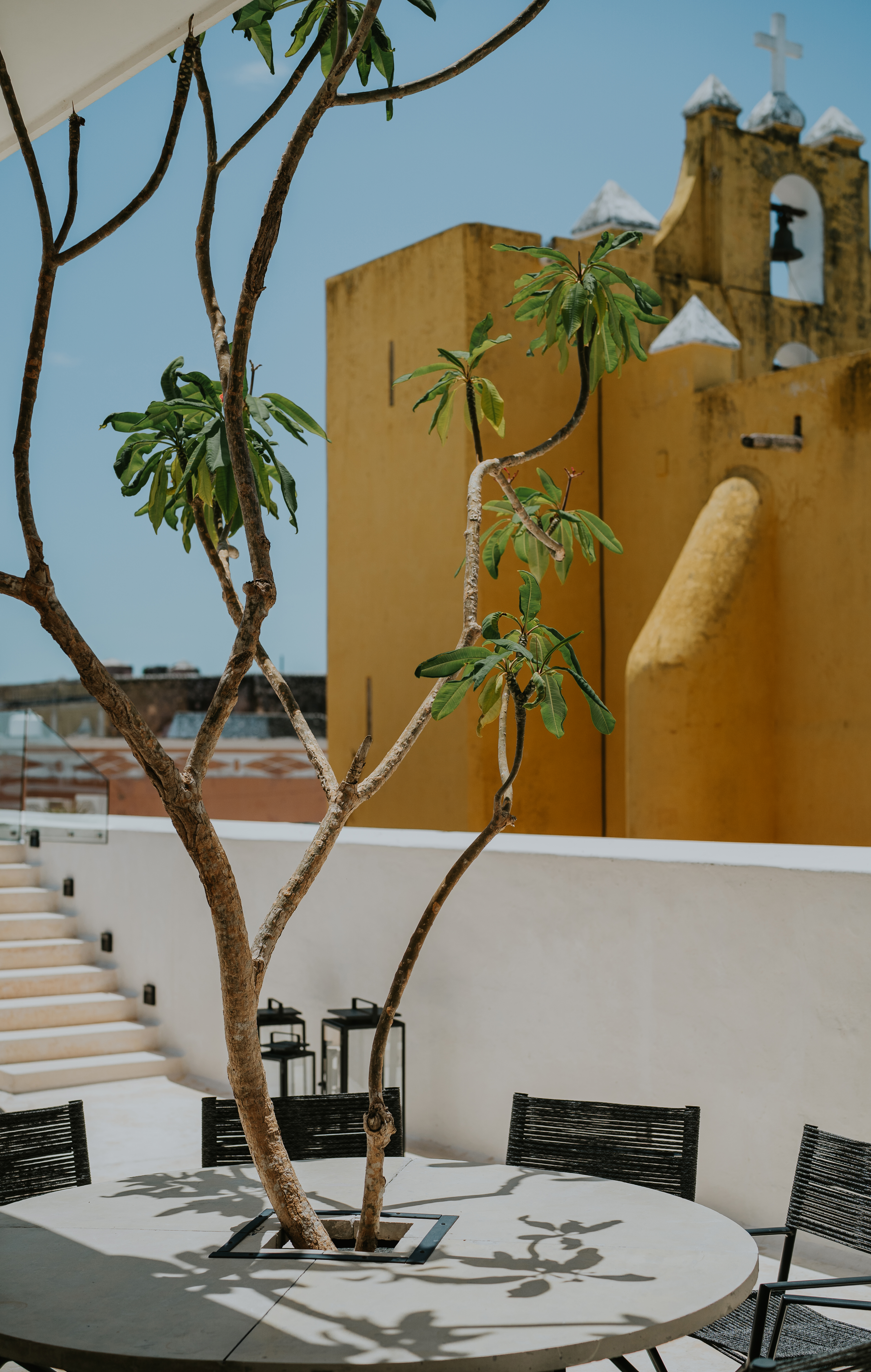
Summary
San Francisco de Campeche is the capital of Campeche state, on Mexico's Yucatán Peninsula. Its walled historic center was declared a UNESCO World Heritage Site in 1999, recognized for the preservation of its 17th-century city wall (1686–1704), its eight bastions, and more than 1,000 colonial buildings. Staying inside the walls is the experience that matters — not a marketing detail. Here's what's worth knowing before you come.
What "the walled city" actually is
The walled enclosure of Campeche is an irregular polygon of roughly 45 hectares ringed by a masonry wall up to 2.5 meters thick and 6 to 8 meters tall. It contains about 80 city blocks following the original colonial grid — numbered streets (even numbers running north-south, odd numbers east-west) and adjoining houses with flat facades painted in the historic chromatic palette.
Construction began in 1686, after the pirate assault of 1685 — one of the traumatic events that drove the Spanish Crown to fortify the city. The works were completed in 1704. At the time, Campeche was the only authorized port for trade in palo de tinte (Haematoxylum campechianum, a red dye critical to European textiles), which explains the defensive investment.
The eight bastions
The wall included eight bastions — small angular fortifications at strategic corners. All eight survive today and most are visitable as small museums:
- Baluarte de la Soledad — houses the Museum of Maya Architecture, with original pieces from Edzná, Calakmul, and other nearby sites.
- Baluarte de San Carlos — the oldest (1676, predating the complete wall), preserves a "dungeon" on its lower level and offers panoramic views from the roof.
- Baluarte de Santiago — restored, contains a small botanical garden of local plants.
- Baluarte de San Pedro — Museum of Traditional Maya Culture.
- Baluarte de la Santa Cruz, Baluarte de San Francisco, Baluarte de San Juan, Baluarte de Nuestra Señora — all integrated into the walking circuit.
Walking the full perimeter takes about 2 hours at a normal pace. The cleanest views of the Gulf of Mexico are from the western side — Baluartes de Santiago and la Soledad — especially at sunset.
The streets that matter
Calle 59 — the pedestrian street
The promenade. It closes to cars at the Zócalo and runs to the Baluarte de San Francisco. Pastel facades, cafés with tables outside, buskers at sunset. Three of Casonas MX's Narrativ lofts (Lira, Numen, Solario, Serena) are literally above this street.
Calle 8 — the sea street
Parallel to the Malecón. It contains the entrance to the Baluarte de la Soledad and several museums. The best route to the Malecón in the late afternoon, avoiding the strongest interior heat.
Calle 55 — the casona diagonal
Where Casa Japa is. One of the streets with the best-preserved facades of the larger casonas — worth walking slowly one morning and paying attention to the details: zaguanes, ironwork, cornices.
The numbered street system
Campeche uses numbered streets like Mérida and other cities in the region: even numbers (8, 10, 12...) run north-south, odd numbers (51, 53, 55...) run east-west. Numbering increases southward and westward. Once you understand the system, navigating the historic center on foot is trivial — addresses like "Calle 55 No. 17" become fully readable.
The Zócalo and the Cathedral
The Zócalo (Plaza de la Independencia) is the heart of the city — kiosks, palm trees, iron benches, food carts at sunset. The Cathedral of Our Lady of the Immaculate Conception dominates the north side. Its construction began in 1540 and stretched across nearly three centuries — which explains the asymmetric towers, one taller than the other, completed at different times.
Across the Zócalo from the Cathedral stands the Centro Cultural Casa No. 6 — a restored 19th-century mansion, now a museum of colonial domestic life. Low entry fee, an hour is enough.
The Malecón and sunset
The Malecón runs 4 kilometers along the Gulf of Mexico. The most interesting walkable section runs from the Baluarte de la Soledad to the Baluarte de San Francisco — about 1.5 km, ideal between 6:00 and 7:00 PM when the sun enters the sea and the palms become silhouettes.
The Malecón is where Campechanos exercise in the late afternoon — runners, cyclists, dog walkers. It's the open-air relief from a city that during the day can feel hot inside the walls.
Why staying inside the walls matters
There are hotels and Airbnbs around Campeche, especially in the modern colonias beyond the Anillo Periférico. Staying outside the walled enclosure means taking a taxi or driving every time you want to walk, eat, or visit a bastion. It means not hearing the Cathedral bells or the buskers on Calle 59 at night. It means treating the walled city like a theme park you visit and leave.
Staying inside the walls turns the historic city into your home for a few days. You walk out for breakfast at the corner café, you come back home for siesta when the heat peaks, you go back out at the cool of 6 PM. It's a different experience — and it's the reason Casonas MX exists exclusively inside the UNESCO polygon.
Eating inside the walled city
- La Pigua (Calle 8) — the most acclaimed for seafood and Campeche cuisine. Pan de cazón, papadzules, coconut shrimp. Reservations recommended.
- Marganzo — institutional for breakfast and lunch. Palm courtyard, extensive menu, embroidered tablecloths.
- Casa Vieja de los Arcos — second-floor balcony facing the Zócalo, a good spot for dinner overlooking sunset.
- Mercado Pedro Sainz de Baranda — the public market, right at the edge of the enclosure. Traditional cooks, cochinita, seafood. The most authentic experience, lowest prices.
- Specialty cafés — Tucán, Chocol Ha, Hostería del Marqués. Good for breakfast, midday breaks, or informal work spaces.
How many days you actually need
Three to four nights let you experience the walled city without rushing — walking the perimeter, visiting the main bastions, the two museums, eating well, watching a couple of sunsets at the Malecón. If you plan excursions to Edzná (1 hour) or the beaches at Champotón (1.5 hours), add a night or two. For Calakmul (4 hours away with overnight stay), plan 6 to 7 nights total.
Where to stay inside the walls
Casonas MX has twelve properties inside the walled enclosure, distributed across the different quadrants:
- For couples: Casa Muralla (built against the wall) or any of the Narrativ lofts.
- For families or small groups: Casa Zotz, Casa Pistache, or Casa Estrada.
- For larger groups or weddings: Casa Japa, La Casa Verde, and combinations of several houses.
- For digital nomads: Casa Pistache (250 Mbps WiFi) or the Narrativ lofts.
More detail on the dedicated pages: for couples, for groups, for digital nomads, for cultural travelers.
Ready to stay inside the walls?
Twelve restored private homes, all within the UNESCO polygon. Real-time availability and best rates direct.
Check Availability